
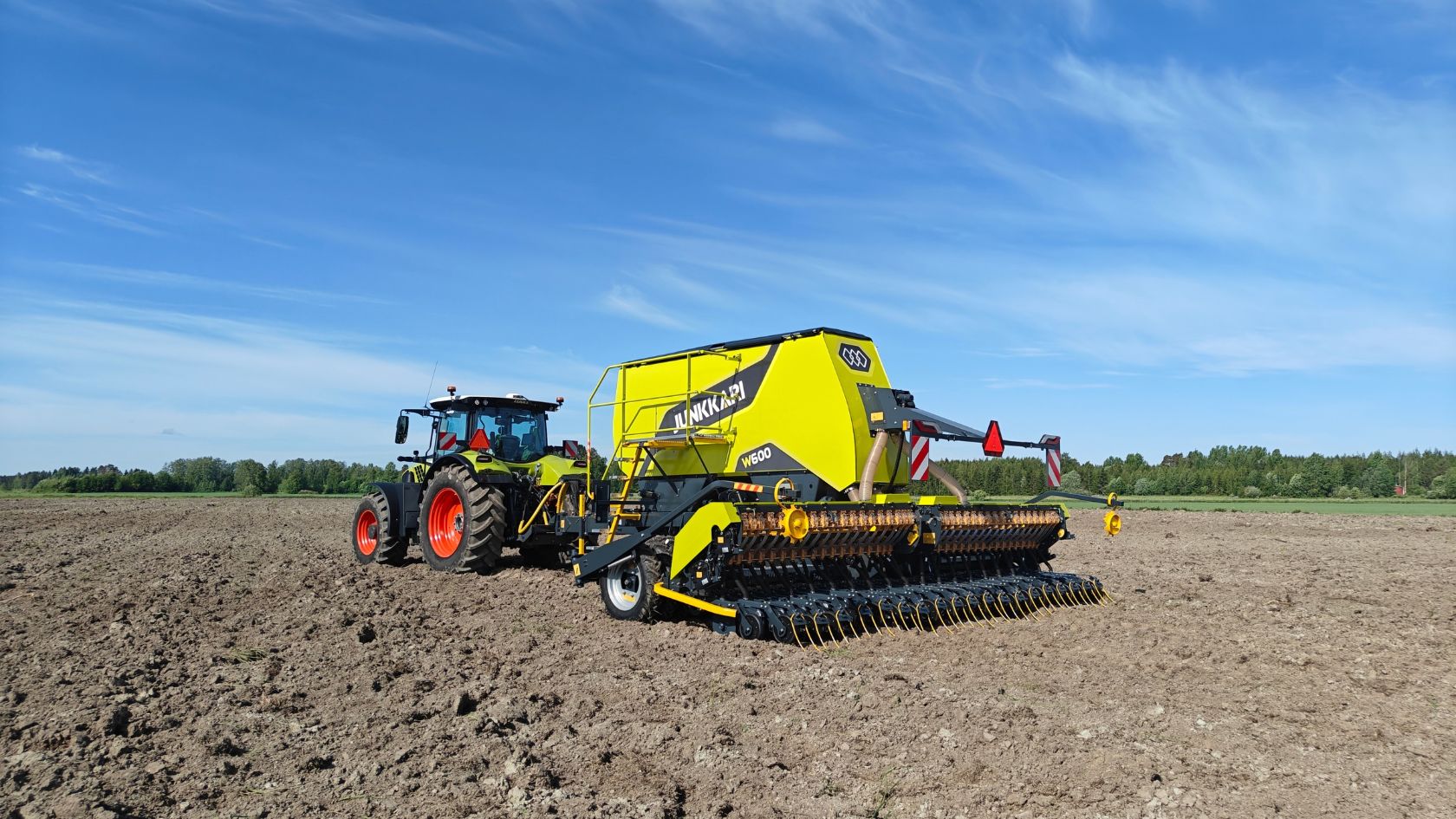
Higher fuel costs are making farmers look more closely at the running costs of their seed drills. The Junkkari W range offers working widths of six or seven metres, with tractor power requirements starting at 150 hp. In suitable conditions, a tractor with less than 200 hp is enough.
Grain prices and production costs are leaving many farms with tighter margins. Fuel is needed for soil preparation, sowing, harvesting and drying. When reviewing costs, it is worth looking at how much power the seed drill needs.
Farmers considering a wider seed drill often need to check whether their current tractor can pull it. If a new drill also requires a larger tractor, the total investment increases considerably.
How much tractor power does the Junkkari W need?
Tractor power requirements for the Junkkari W600 and W700 seed drills start at 150 hp. The six-metre W600 and seven-metre W700 can therefore be suitable for tractors with less than 200 hp.
The power needed depends on field conditions and the drill’s equipment. Soft ground, slopes and higher working speeds increase power requirements. The optional disc cultivator also requires more power.
If the current tractor is suitable for the W model, the farm can increase its sowing capacity by replacing the drill without investing in another tractor.
Mechanical metering needs no fan power
In the Junkkari W model, seeds and fertiliser are moved by gravity and augers. The metering system is driven by the roller wheels. No fan is needed to transport the material, so no power is used to run one. The transfer augers require a hydraulic flow of 20 litres per minute.
Filling trips are part of sowing costs
Working width alone does not determine sowing capacity. The number of stops for refilling also matters.
The W model’s 7,150-litre hopper, the largest on the market, allows long periods of sowing between refills. The area covered with one fill depends on the seed type and the seed and fertiliser application rates.
A large hopper is especially useful when the filling point is far from the field. Every avoided filling trip reduces transport and leaves more time for sowing.
It is worth looking at the whole working day. How much time is spent sowing, refilling and travelling between fields and the filling point?
What affects fuel consumption during sowing?
The drill’s power requirement alone does not tell you how much fuel will be used. Fuel consumption also depends on the tractor, working speed, how well the soil supports the machine and the drill’s equipment. Actual consumption can only be measured during field work.
Track fuel consumption in litres per hectare sown. When comparing results, include filling trips and other transport, and use the same measurement method each time.
Explore the Junkkari W range and contact our sales team. We will help you find a seed drill that suits your fields and your current tractor.
Contact your nearest Junkkari dealer to find a seed drill that suits your fields and your current tractor.